
Picture a hard spring rain. Water pours off the roof, but instead of heading for the downspout, it spills over one end of the trough and splashes against your foundation. Two days later, a puddle is still sitting inside. In most cases, the cause is gutter pitch, the gentle downward slope that moves water toward the outlet. The usual target is about 1/4 inch of drop for every 10 feet. We install and adjust seamless gutters on homes across north-central Massachusetts and southern New Hampshire, and this guide reflects what we see on local roofs every season.
In this article, you’ll learn:
- What gutter pitch means and why installers treat “pitch” and “slope” as the same thing.
- The recommended pitch per 10 feet and how to work out the total drop for any run on your house.
- How to spot the warning signs of poor pitch and tell them apart from an ordinary clog.
- Why snow, ice, and freeze-thaw cycles make correct pitch even more important here in New England.
- When a pitch problem can simply be adjusted and when new seamless gutters are the smarter investment.
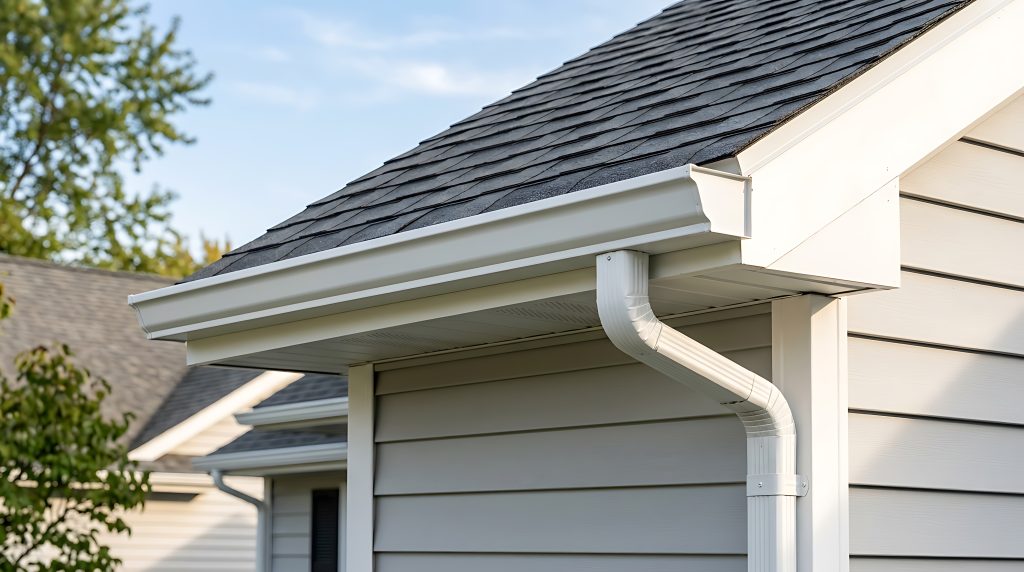
What Is Gutter Pitch?
Gutter pitch is the slight downward angle a gutter is hung at so gravity carries rainwater toward the downspout. The trough stays level from front to back, which keeps water from spilling over the outer lip, while it tilts gradually along its length. On a properly installed run, you won’t notice the slope from the street. That’s intentional. The drop is small enough to look straight and large enough to keep water moving.
Is Gutter Pitch the Same as Gutter Slope?
Yes. Pitch, slope, and “fall” all describe the same lengthwise drop, so you’ll see contractors use them interchangeably. One point trips up many homeowners, though. Gutter slope has nothing to do with roof pitch, the steepness of the roof itself (for example, a 6/12 roof). A steep or shallow roof can affect how much water reaches the eave, but the lengthwise tilt of the trough is set separately.
Why Does Gutter Pitch Matter for Drainage?
Without enough pitch, water sits instead of leaving, and standing water causes most of the damage a drainage system exists to prevent.
The problem tends to feed itself. Water and shingle grit collect in a low spot and add weight. That weight strains the hangers, which loosen and let the section droop a little further. The deeper low spot then holds even more water, and the cycle repeats with every storm.
Over time, poor gutter drainage can lead to rotted fascia and soffit boards, overflow that erodes soil and soaks the foundation, rust or failed sealant at seams and corners, and stagnant water where mosquitoes breed. None of these happen overnight. They build quietly until a repair becomes far larger than the original issue.
How Much Pitch Should Gutters Have?
Most gutters should have about 1/4 inch of drop for every 10 feet, with a working range of roughly 1/8 to 1/2 inch per 10 feet.
Why a range instead of one fixed number? It comes down to a tradeoff between capacity and appearance. A steeper slope moves water faster and handles heavier downpours, but over a long stretch it can make the trough look crooked from the yard. Too little fall lets water linger after the rain stops.
The right setting also depends on how much roof area drains into that section, where the downspouts sit, and the size of the gutter. That’s why we set pitch run by run during every installation rather than applying a single rule to the whole house.
How Do You Calculate the Total Drop for a Gutter Run?
Divide the length of the run by 10, then multiply by 1/4 inch. The result tells you how much lower the downspout end should sit compared with the high end.
| Gutter Run Length | Total Drop at 1/4 Inch per 10 Feet |
|---|---|
| 10 feet | 1/4 inch |
| 20 feet | 1/2 inch |
| 30 feet | 3/4 inch |
| 40 feet | 1 inch |
Should Long Gutter Runs Be Pitched From the Middle?
Often, yes. On runs longer than about 40 feet, installers commonly place the high point near the center and slope each half toward its own downspout. Splitting the run this way keeps the drop at each end small. The trough looks straighter, stays tucked neatly under the roof edge, and each downspout handles only half the water.
What Happens When Gutter Pitch Is Too Flat or Too Steep?
Both extremes cause trouble, just in different ways. A flat or reversed slope traps water, while an overly steep one creates gaps and overwhelms the outlet.
| Pitch Condition | What You Notice | Likely Result |
|---|---|---|
| Too flat or back-pitched | Standing water, drips long after rain, piles of grit | Sagging, rust, fascia rot, ice buildup in winter |
| Correct (about 1/4 inch per 10 feet) | Trough empties shortly after rain stops | Steady drainage with no visible tilt |
| Too steep | Visible tilt, gap under the roof edge at the low end, water rushing past the outlet | Overshoot at the downspout, water running behind the gutter |
What Are the Signs of Improper Gutter Pitch?
The clearest sign is water collecting or escaping anywhere other than the downspout. Many of these red flags are the same issues professionals look for during a gutter and downspout inspection. Here’s what to watch for:
- Water spilling from the end opposite the downspout. This usually means the run has become back-pitched and water is flowing the wrong way.
- Standing water a day or more after rain. A puddle that lingers points to a low spot where the slope has dipped.
- Drips or leaks at corners. Two connected sections that no longer meet at the right height will trap water at the joint and wear out the sealant.
- Shingle grit or debris piling up away from the outlet. Heavy grit settles at the lowest point, so buildup in the middle of a run tells you where the dip is.
- Rust, stains, or streaks in one area. Discoloration on the face of the trough or the siding below shows where water has been sitting or overflowing repeatedly.
- Heavy icicles in the same spots every winter. Ice forms where meltwater pools instead of draining.
- A visible sag or a gap between the gutter and the fascia. Either one signals that fasteners are failing and gutter alignment has shifted.
How can you tell a pitch problem from a clog? A clog usually clears once the debris is removed. A pitch issue keeps returning to the same spot after every storm, even when the system is clean. If you’re seeing repeat trouble, our gutter evaluation and repairs service can pinpoint the cause.
Why Do Gutters Lose Their Pitch Over Time?

Most gutters start with the right pitch and lose it gradually through weight and wear. Spike-and-ferrule fasteners, still common on older homes, tend to work loose as wood expands and contracts. Leaves and grit add steady weight, and snow and ice add even more each winter.
The fascia matters too. Once that board softens or rots, it can no longer hold fasteners tightly, and the trough begins to droop. In some cases, the slope was simply set wrong on day one and the problem took a few seasons to show.
Seamless gutters with hidden hangers screwed into solid wood hold their slope far longer than sectional systems on spikes. When the fascia itself is damaged, our fascia repair and carpentry work gives new hangers a sound surface to anchor into.
How Is Gutter Pitch Different From Gutter Alignment?
Pitch is the lengthwise slope, while alignment describes how the whole gutter sits against the fascia and beneath the roof edge. A run can have perfect pitch and still be misaligned, letting water slip behind it and soak the wood.
This becomes more noticeable on steeply pitched runs. As the trough drops toward the downspout, a gap can open between the drip edge and the back of the gutter. Rain then finds its way down the fascia instead of into the trough. Reverse flashing and roof edge flashing close that gap and guide water where it belongs, which is one reason we look at the entire roof edge, not just the slope.
Why Does Gutter Pitch Matter More in New England Winters?
In our climate, water that doesn’t drain freezes, and that ice adds weight while blocking the path for the next melt.
A low spot that holds a little rainwater in October can hold a solid block of ice by January. Every thaw sends fresh meltwater into a trough that’s already full, so it refreezes, spills over, and forms icicles along the edge. The extra load pulls on hangers and can deepen the very sag that started the problem.
Poor gutter drainage at the eave can also make ice buildup along the roof edge worse. If ice dams are a recurring headache at your house, our ice dam solutions page explains how we approach them. Adding gutter guards helps as well, since keeping leaves and needles out reduces the weight that drags a system out of pitch.
How Can You Check Your Gutter Pitch Safely?
Start from the ground during or after rain, and only climb a ladder if you’re comfortable and have someone to help. There are three simple ways to check.
First, watch your roofline during a steady rain. Note any spot where water spills over the edge or drips from a corner instead of running to the downspout.
Second, run a garden hose at the high end of a run and watch the flow. Water should travel steadily toward the outlet without stalling or backing up.
Third, set a level inside the trough. The bubble should show a slight fall toward the downspout, never a flat reading or a tilt in the opposite direction.
Please be careful. Avoid leaning ladders against the gutter itself, stay well clear of power lines, and never step onto a wet or icy roof. If anything feels uncertain, it’s a job for a professional.
Can Gutter Pitch Be Fixed, or Do You Need New Gutters?
If the gutters and fascia are in good shape, re-hanging them at the correct pitch is often all you need. When the system is worn or the problems are widespread, replacement usually makes more sense.
| Re-Pitching Usually Works When | Replacement Usually Makes More Sense When |
|---|---|
| Gutters are sound, straight, and leak free | Gutters are dented, warped, or have been repaired many times |
| The issue is limited to one run or a few hangers | Several runs and corners are out of alignment |
| Fascia is solid | Fascia is rotted and needs repair first |
| Hangers are hidden screws in good condition | The system relies on spike-and-ferrule fasteners |
Because connected sections must line up as a whole, fixing one stretch on an older multi-section system rarely solves everything. In those cases, a new seamless system set at the right slope from the start tends to be the more lasting answer. Curious how we handle that process? You can see the steps on our Our Process page.
Is It Time to Have a Professional Look at Your Gutters?
If water keeps collecting in the same place, there’s a good chance you’re dealing with a pitch or alignment issue, and it’s far easier to correct before winter sets in. Our family-owned team has been protecting homes in Westford, Chelmsford, Acton, Groton, Littleton, and nearby towns, along with Hollis and Brookline, NH, for over two decades. You can view our full service area to confirm we cover your neighborhood.
Contact Us To Schedule a Free Estimate or call us at (508) 572-5557. We’ll check your gutter pitch, alignment, and drainage, then give you honest recommendations for your home.